
An independent reading of the rules, and the people on either side of it
This site did not write any of the rules it explains, and it cannot change any of them. What it can do is read all of them in one pass, put the contradictions next to each other, and name the article every figure came from so you can check the wording yourself.
Written by one editor at [email protected]. Published rules last read on 2026-09-24.
What is Hubbuy, in its own words
The service role description is three sentences long and each one is doing real work. The first is the job description: assistance in purchasing goods from China, order processing, warehousing, basic quality inspection, packing and international forwarding. A shopping agent that acts on your behalf, in other words, at every step between a Chinese seller and your door.
The second sentence is the disclaimer, and it is the one worth reading twice. Hubbuy is not the manufacturer, the brand owner, or the actual seller of anything listed on a third-party platform, and product information, quality, authenticity and intellectual property status are described as generally provided by third-party sellers. Everything you are buying is described by somebody else.
The third is the reservation of a right to refuse. To comply with laws, customs rules, payment-provider requirements and carrier rules, the operator may review goods, orders, accounts and parcels, and may refuse to process anything presenting legal, infringement, safety or shipping risk. What that refusal looks like in practice.

Why this site exists, and when you should use a different one
Three honest parts, in the order that is useful rather than the order that flatters. Most of what a guide site can tell you about an agent is true of every agent, and saying so first is the only way the rest of it means anything.
First, what every agent does the same way
They all buy from the same Chinese platforms, hold parcels in a warehouse near the same ports, photograph goods on arrival, consolidate boxes and hand them to the same handful of carriers. Route names, transit times and seizure rates belong to the carrier and the destination customs office, not to whoever booked the label. Anyone selling you a choice between agents on those grounds is selling you the carrier.
Second, what we do differently here
This site reads the published rules end to end and reproduces them as pictures with the source article named. That turns up things a summary never does: an overview stating one flat compensation cap while its own attachment publishes higher ones for two routes and zero for three, a fee ladder whose first band is free, an inspection scope that names what it will not do. The largest contradiction, both halves side by side.
Third, when you should use a different site instead
If you want a live shipping quote, a current exchange rate, a tracking lookup or an order placed, go to the operator directly, because none of those exist here and a page that pretended otherwise would be wasting your time. If you want prices, go to the catalogue. This site is only useful for the questions whose answers are written down in a rule.
What this is worth, stated plainly
Reading the rules first changes perhaps three decisions: whether to buy insurance, whether to open a sealed box before the return window closes, and whether to order the category that gets pulled at the warehouse. Each of those is irreversible afterwards. That is the whole argument.
Seven risks the operator publishes against itself
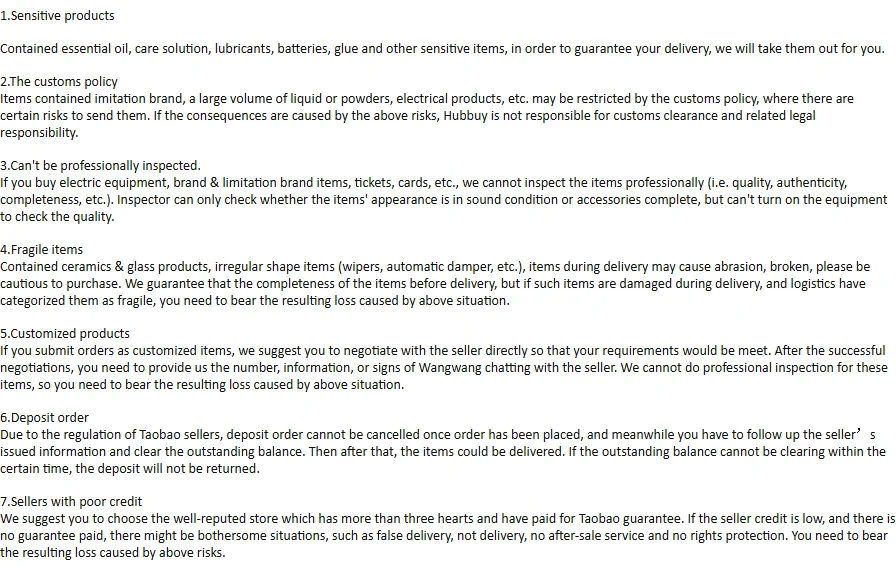
The disclaimer for proxy purchase and shipped goods opens with a pointer: for prohibited goods, intellectual property, refusal and refund handling, the compliance policy prevails, and this article covers inspection and shipping risk for special goods instead. What follows is a numbered list that is unusually frank about the limits of the service.
Sensitive contents get removed rather than shipped. Imitation brands, bulk liquids, powders and electricals may be stopped by customs, and the operator states it is not responsible for clearance in those cases. Electrical equipment, branded goods, tickets and cards cannot be professionally inspected at all: the inspector checks appearance and completeness and cannot turn the equipment on. What the inspection does cover.
Fragile goods carry a split guarantee, complete before delivery but yours once damaged in transit. Customised orders are negotiated with the seller directly and are not professionally inspected. A deposit order on a Chinese platform cannot be cancelled once placed, and a balance left unpaid loses the deposit. The last item is advice rather than a rule, on choosing sellers with credit and a paid guarantee. How to read a listing before you order.

How to judge an agent from its published rules alone
You cannot test an agent before committing to one, and reviews are written by people with a different order, a different route and a different destination. What you can do before spending anything is read what it has committed to in writing, because that is the document anybody will be arguing from later. These are the things worth reading for.
Signals you can check yourself, for free
- Whether the rules contradict each other, and which version the operator reaches for when they do. A live example.
- Whether the inspection scope is written down at all, and whether it is honest about what it will not do. An agent that names its limits has thought about them. This one names them.
- Whether the return clock has a defined start. A window measured from an undefined moment is not a window. Where this one starts.
- Whether the evidence a claim needs is specified before the claim, not after. Anything demanded afterwards is unobtainable by definition.
Signals that look reassuring and mean nothing
- A long list of destination countries. Every forwarder resells the same carrier networks and can list them all.
- Promised transit times. Those belong to the carrier and to the customs office at the other end, neither of which the agent employs.
- Community size. It measures how many people arrived, not how any of them were treated when something went wrong.
- A rating displayed on a page the operator controls. The published rules are also operator controlled, but they are the thing you can hold it to.
What is asked of you in return
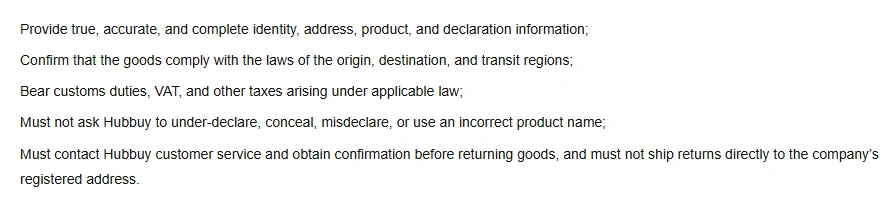
The user responsibilities article is five lines long and four of them are about declarations. Provide true, accurate and complete identity, address, product and declaration information. Confirm the goods comply with the laws of the origin, destination and transit regions, which quietly makes transit countries your problem too. Bear customs duties, VAT and other taxes. And do not ask the operator to under-declare, conceal, misdeclare or use an incorrect product name. What a declaration decides.
The fifth is operational and easy to get wrong in a hurry: contact customer service and obtain confirmation before returning goods, and never ship a return straight to the registered company address. A parcel sent to the wrong door is outside every published process.
The disclaimer closes with a category of its own and then a general acknowledgement. Sealed collectible items are never unwrapped during inspection, so only the exterior is checked and the contents cannot be verified. And placing an order carrying any of the listed risks is treated as having read and accepted the terms, with interpretation reserved by the operator. That last clause is worth knowing about before a dispute rather than during one.

Who writes this, and how it pays for itself
Fair questions to ask of anything that explains a service it is also sending you towards. Answered directly.
- Who writes these pages?
- One editor, reachable at [email protected]. Not a team, not a company, and not anybody who works for the operator. Every page names the date it was reviewed.
- Is this the operator site?
- No. It is independent and it is a partner, which means it earns from the traffic it sends to the official site. It sells nothing, holds no stock, takes no payments, ships nothing, and cannot decide or influence any claim.
- Why is so much of it screenshots?
- Because a paraphrase of a rule is an opinion about a rule. Reproducing the published wording means you can disagree with the reading on this page and still have the primary source in front of you.
- How do I know a figure has not been edited?
- Each one names the article it came from and the date it was read, so it can be checked against the live page. Crops are only cropped, never retyped. Where a source capture turned out to contain a real customer name and address, that capture is not used on this site at all, rather than blurred and used anyway.
- What if a rule has changed since you read it?
- Then this page is wrong and the operator page is right. That risk is the reason for the log. What this reading found.
Four things this site will not do
Stated here so they can be held against it. A guide that does any of these has stopped being useful, whatever else it gets right.
It will not quote a price, a rate or a delivery time
All three move faster than a static page can track, and a stale number is worse than no number because it looks like information. What that leaves it able to say about money.
It will not tell you a claim will succeed
It can tell you what the published rule requires and what the published exclusions say. The decision belongs to people this site has never spoken to. The exclusions, all ten.
It will not resolve a contradiction the operator has not resolved
Where two documents disagree, both get shown. Picking a winner would invent certainty that does not exist, and you would plan around it.
It will not sell you anything or handle your money
No accounts, no checkout, no balance, no stock. The only thing leaving this site is a link.