
The window that closes five days after the parcel reaches the warehouse
A return here is not a return to the operator. It is a return to the original seller, arranged on your behalf, which is why it costs two legs of domestic freight and why the seller can refuse it. The clock that matters starts when the order status changes to stocked in, and it runs for five days.
Return requests are raised from the order page on the operator's site.
Four things that have to be true before a return is possible
All four, at once. Missing any one of them takes the order out of the guarantee entirely, and the published answer for orders outside the guarantee is that the operator will try to talk to the seller rather than that it will arrange anything.
The seller offered guaranteed returns in the first place
This is a property of the listing, not of the agent. It can be checked before you order and it cannot be changed afterwards. What else to read off a listing.
The item is still in a re-salable condition as the seller defines it
For most categories that means unworn and unused. For a long list of others it means the factory seal is still unbroken, which is a decision you make at the moment you ask for an inspection. The table.
It has been in the warehouse for no more than five days
The window runs from the stocked in status, not from delivery to the warehouse door and not from your payment. Past it, the published wording is that the request might not be accepted.
Your account balance can cover the freight before you ask
Both legs of domestic shipping and the service fee come out of the balance, and the request cannot proceed without it. What each leg costs.
The two published lists, and which one your order is on
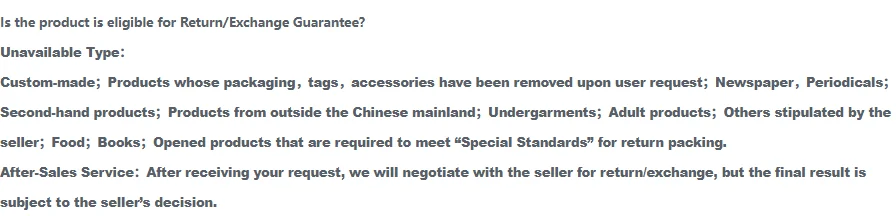
The operator splits every order into an unavailable type and an available type, and the unavailable list is the one to read first because it is specific. Custom made goods. Anything whose packaging, tags or accessories were removed at your own request. Second hand products. Goods from outside the Chinese mainland. Undergarments, adult products, food, books, newspapers and periodicals. Plus a catch all for anything else the seller stipulates.
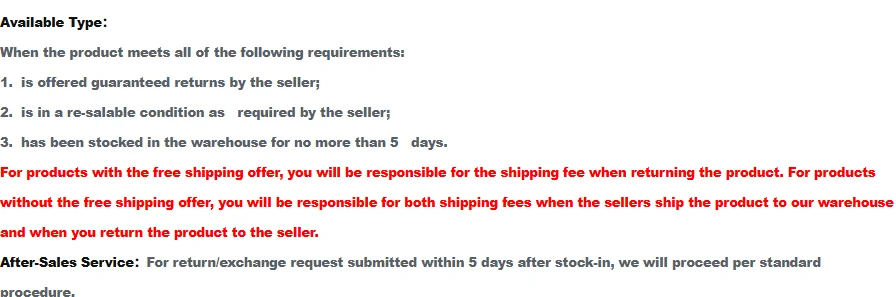
The available list is three conditions long and the third one is the clock. Underneath it, in red, sits the sentence that decides the bill: with a free shipping offer you pay the return leg, and without one you pay both legs, the seller to warehouse leg as well as the warehouse to seller leg. The after sales line under the unavailable list is equally blunt: the operator will negotiate, but the final result is the seller decision.
Where the five day clock actually starts
The wording here is worth being precise about, because there are three moments it could plausibly mean and only one of them counts. Not when the seller ships. Not when the courier scans the parcel into the building. The clock starts when the order status on your page changes to stocked in, and the request is raised from that same page.
That is a status you have to go and look at. Nothing about it arrives in your inbox, and the difference between noticing it on day one and noticing it on day six is the difference between a free return and no return at all. What the inspection photographs can settle.

What the bill is made of
The published formula has three terms, and only the third one is the operator charge. Shipping to the seller, shipping from the seller, and a return or exchange service fee. On a low value item the two freight legs routinely cost more than the goods, which is the practical reason most returns from this kind of order are not worth making.
The third term is currently annotated as free for a limited time. That is a promotional state rather than the published standard, so this page reads the ladder underneath it as the thing to plan around. A limited time offer is not a number you can budget against.

The service fee ladder, drawn to one scale
The ladder is counted per calendar month and it counts returns and exchanges separately, with exchanges charged at double the return rate at every step. The first one or two of each are free, which is why the bars below start at the second band: an empty bar on this site means no cover, not no charge, and the two are not the same thing.
Worth knowing before the count matters: the deduction happens when the order status becomes Return, and submitting several at once can leave the remaining free count stale for a while. Every figure here is read off the operator's own table on 2026-09-24.
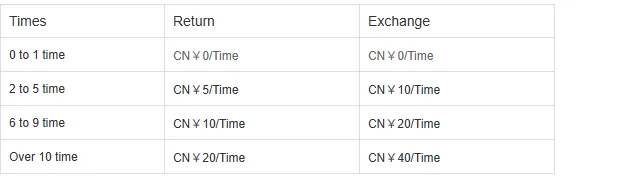
Return and exchange service fee per occurrence, counted per calendar month, in yuan
2 to 5 timesper month
The first band that costs anything. Freight is on top of this, both legs.
6 to 9 timesper month
Doubles at the sixth, which is also where the separately published worked example lands.
over 10 timesper month
The top band. Nothing in the article caps the count itself.
Who is held responsible, case by case
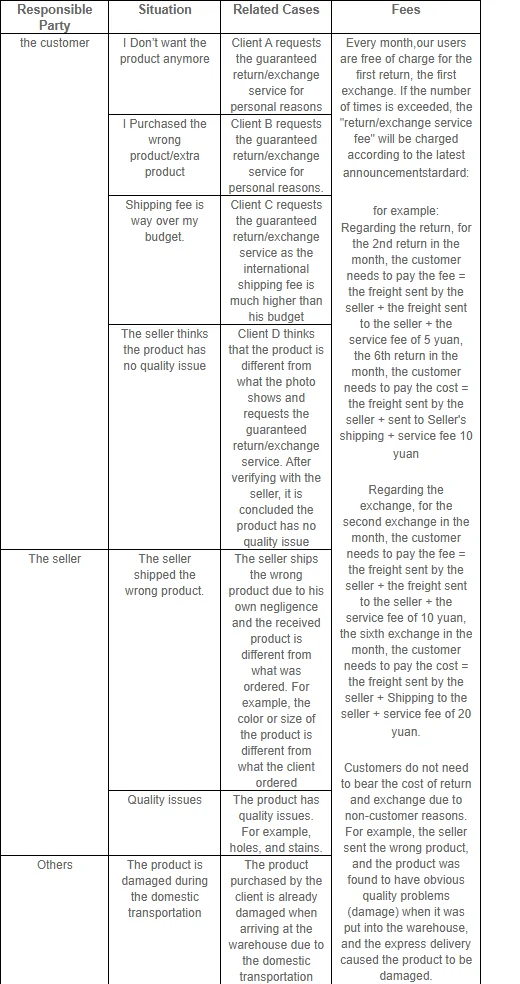
This table is reproduced whole rather than split, because the fee column runs across all of its rows and cutting it anywhere leaves half a sentence on each side. It sorts every situation into three responsible parties and names a worked example for each.
The customer rows are the ones to read closely. Changing your mind, ordering the wrong thing, and deciding the international shipping is over your budget all sit in the same bracket. So does the case where you think the item differs from the photographs but the seller disagrees and the operator, after checking, concludes there is no quality issue. The seller rows cover the wrong item shipped and genuine quality problems such as holes and stains, and those do not come out of your balance. Damage in domestic transit is filed separately again.
Four conditions printed under the formula
Short, easy to skim past, and each one changes something. The refund is calculated on what you actually paid rather than on the listed price, which matters on anything bought during a promotion. The operator can only act when the seller agrees, which is the same limit stated under the unavailable list.
The third is the one that catches people: the balance has to be there at the moment you request, not at the moment the freight is billed. And the fourth points at the packing table, with the consequence spelled out: if the requirement is not met, the return cannot happen at all. The table it points at.

The most candid paragraph in the help centre
One of the published questions asks why you still pay freight when the seller offered free shipping and shipping insurance. The answer does not reach for a policy. It explains the commercial reason, and in doing so the operator says something about its own account that it had no obligation to say. It is reproduced here word for word.
For the shipping insurance, the compensation from the insurance company is determined by the rate of product return and our sourcing account has a high rate of product return. It is possible that the insurance company will decline the claim so the shipping insurance may not work.
Question five of Return and Exchange Service, read on 2026-09-24.
The categories where the decision is made before you look
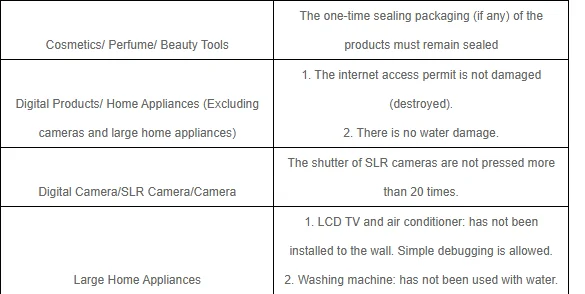
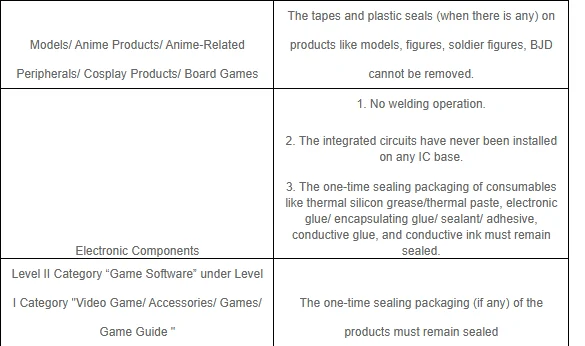
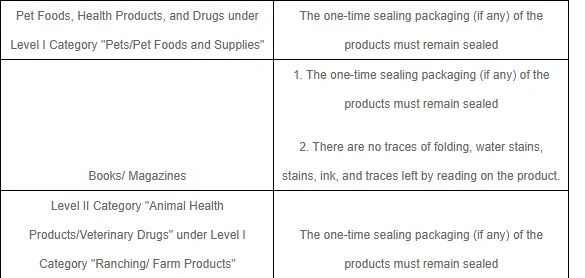
The packing table is the part of this article with real teeth, and it is long. Cosmetics, perfume and beauty tools have to keep the one time sealing packaging sealed. Digital products and home appliances need an undamaged internet access permit and no water damage. Models, figures and board games must keep their tapes and plastic seals. Electronic components must not have been soldered or seated in an IC base.
The most specific line in the whole help centre sits in the middle of it: the shutter of an SLR camera must not have been pressed more than 20 times. Large appliances get their own pair of conditions, a wall mounted television or air conditioner being disqualified by installation while simple debugging is allowed, and a washing machine by having been run with water.
Read against the inspection rules this produces the trap this site keeps coming back to. A sealed item cannot be inspected without being opened, and opening it ends the return right. What the warehouse will and will not open.
What the word sealed is taken to mean
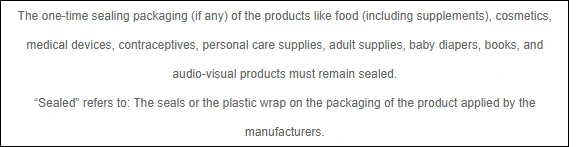
The table closes by defining its own key term, and the definition is narrower than the everyday use of the word. Sealed refers to the seals or the plastic wrap applied by the manufacturer. Not tape you added. Not the shipping bag. Not a box that happens to still be closed.
The same closing paragraph extends the requirement across a wider list than the rows above it: food including supplements, cosmetics, medical devices, contraceptives, personal care supplies, adult supplies, baby diapers, books and audio visual products. If you are ordering anything on that list, the return question is settled the moment the wrap comes off, whoever takes it off and for whatever reason.
Four published answers, reproduced rather than paraphrased
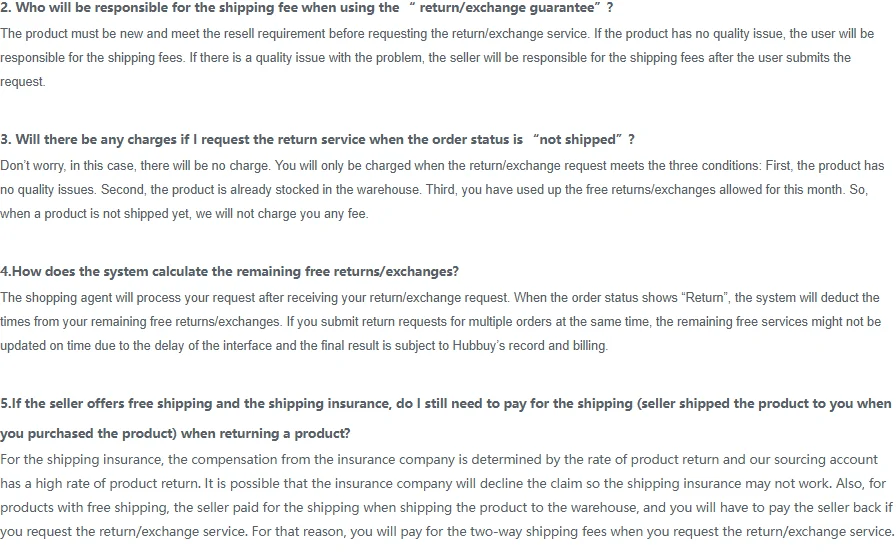
The article ends with its own questions and answers, and they settle things the body text leaves ambiguous. Who pays freight under the guarantee depends entirely on whether there is a quality issue: no issue and it is yours, an issue and it is the seller. A request raised while the order is still not shipped costs nothing, because charging requires all three of no quality issue, already stocked in, and free allowance used up.
The free count is deducted when the status becomes Return, and the answer admits the interface can lag when several requests are submitted together. The fourth answer is the candid one quoted above. Reading them as published is worth more than any summary, which is why the block is reproduced here in full.
Reading the QC photographs against a return you might need
The warehouse quality check happens inside the same five day window, and it is the only look at the item anybody takes before it ships. Knowing how to judge a QC set matters here rather than on a quality page, because the set is the evidence a return request rests on and the operator has published exactly what its quality control does and does not cover. The published inspection scope.
What the photographs can settle
- Wrong item, wrong colour, wrong model or wrong version against the listing. These sit in the seller responsibility rows of the table above.
- Visible damage, holes and stains. The published example of a quality issue names exactly these.
- Whether apparel matches its label and tag, which is the stated basis on which apparel is judged.
- Whether the factory seal is still intact, which decides whether the item is returnable at all. The sealed list.
What they cannot settle
- Whether anything electrical works. The published scope states equipment is not powered on during inspection.
- Colour deviation and wrong sizes, which the same scope excludes by name.
- Whether the seller shipped the batch the photographs in the listing came from, since there is nothing to compare against on a one picture listing.
- Anything at all, on a sealed item, without ending the return right in the process.
If the window has already closed
Three things still exist after day five, and one thing does not. Being clear about which is which saves a lot of wasted correspondence.
The seller conversation, which never depended on the guarantee
The published answer for orders outside the guarantee is that the operator will try to communicate with the seller. That is a real route and it is worth asking for, but it is not an entitlement.
A quality claim, if there genuinely is a quality problem
The article separates quality issues from preference throughout, and the quality path is handled case by case with the seller rather than by the clock.
The insurance route, which covers something else entirely
Cover is for the parcel going missing, not for the contents disappointing you. Worth knowing which one you are actually claiming. What a claim pays.
What does not exist is an unconditional change of mind
Every published path after day five needs either seller agreement or a demonstrable fault. Planning around that before you order is cheaper than discovering it afterwards.