The lists that decide whether a parcel leaves China at all
Three separate sets of rules sit between a listing and a shipping label: what the state prohibits, what it restricts, and what the operator classifies as sensitive. Only the first two can stop a parcel outright. The third one decides how slow and how expensive it gets.
Ordering and route selection both happen on the operator's site.
The state lists, quoted rather than summarised
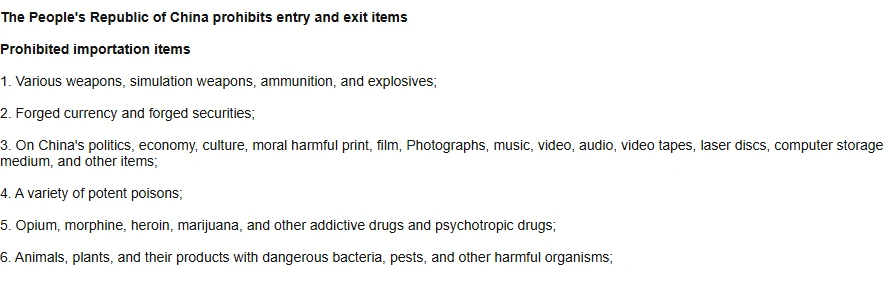
The operator opens this topic by pointing at the law rather than at its own policy: goods bought in China have to conform to the laws of the People's Republic of China, and the governing tables are the prohibited import and export lists that took effect on the first of March 1993, replacing the 1987 announcement.
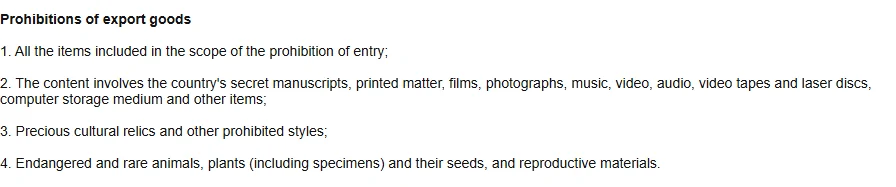
Two lists, and they are not symmetrical. The import list runs to six entries. The export list opens by absorbing the whole import list and then adds four of its own, including precious cultural relics and endangered species. For a normal shopping parcel almost none of it applies, which is exactly why it is worth reading once: it tells you where the hard floor is, so you can stop worrying about it and concentrate on the lists further down this page, which are the ones that actually catch people.
Restricted coming in: five entries, one of them ordinary
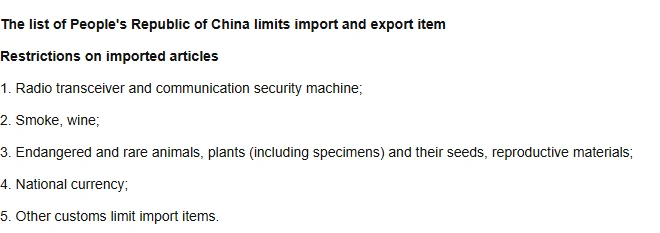
Restricted is a different word from prohibited and it means something different. These goods can move, under licence, with paperwork, through channels a shopping parcel does not have. In practice that reads as a no.
Four of the five are obviously not shopping: radio transmitters, endangered species, national currency, and a catch-all for whatever else customs decides to limit. The fifth is the one worth remembering, because it looks like shopping. Tobacco and alcohol sit on this list. A bottle bought as a gift is not an edge case here, it is the named example.
Restricted going out: seven entries, and the one that catches jewellery
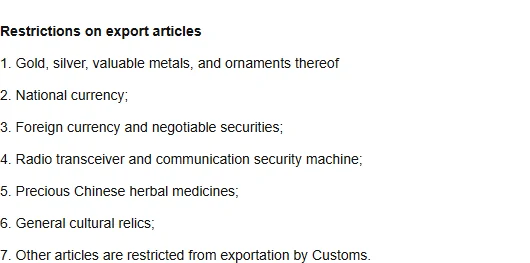
The outbound restricted list is longer, and the first line of it is the one that surprises people who are buying from a jewellery category: gold, silver, valuable metals and ornaments thereof. Not counterfeit jewellery, not fine jewellery, the metal itself.
Read alongside the operator sensitive goods policy, that puts anything sold as solid precious metal in a category of its own. Plated and costume pieces are a different conversation, which is a distinction the listing may not make for you and the warehouse will not make on your behalf. If it matters, ask the seller what the metal is before the parcel exists.
Sensitive goods, category one and category two
Here the rules stop being the state and start being the operator. It publishes a list of ten sensitive categories, and it is explicit that the list is not exhaustive. Sensitive does not mean banned. It means the parcel needs a route that will take it, and the routes that will take it are fewer, slower and dearer than the ones that will not.
The first category is liquids, and the definition is deliberately wide: any product containing a liquid. Face masks, wet wipes and nail polish are named because people do not think of them as liquids. The hard number is that the liquid has to be under 100 ml, and above that it cannot be sent at all.
The second category is magnets, and the reason it catches people is that almost nobody buys a magnet. They buy a speaker, or a pair of noise cancelling headphones, or a fridge decoration. Anything that produces sound contains one.


Batteries and powders, the two that change the price of the parcel
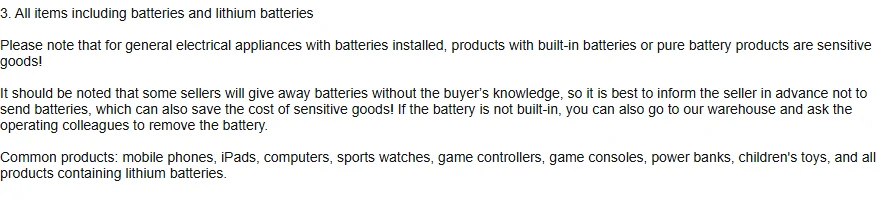
Batteries are the single most common reason a cheap parcel becomes an expensive one, and the operator makes a practical point about them that is worth acting on: some sellers add batteries as a courtesy, without telling you, and that is enough to reclassify the whole parcel. Its advice is to tell the seller in advance not to include them. Where the battery is not built in, the warehouse will remove it on request.
Powders are the category with a genuine prohibition buried inside a sensitive listing. Coloured powders are sensitive, which is the normal slow and expensive treatment. White powder is contraband, stated in those words, and cannot be sent at all. If you are buying milk powder or a pale seasoning, that distinction is not academic. What a claim pays if it goes wrong anyway.

The tenth category, and why it is on the list at all
The list ends somewhere most shoppers would not predict. Religious goods are sensitive, and the operator gives the reason in one sentence: customs inspects goods related to religion more strictly. The named examples are books, ritual props and recordings.
Nothing here is prohibited, and the entry is not a judgement about what you are buying. It is a statement about inspection probability, which is the same thing every other entry on this list is about. Treat it the way you would treat a battery: a reason to expect a slower route and a higher chance of being opened, not a reason to abandon the purchase.

Working around a sensitive category before you order
Nothing on the sensitive list has to sink a purchase. All of it is easier to handle before the item exists in a warehouse than after, because once it is there your options narrow to accepting a route or paying to send it back.
Name the category while you are still on the listing
Liquid, magnet, battery, brand, powder, applied to the body, chip, food, sharp, religion. Most items that get stuck are stuck for one of those ten reasons and it is visible from the product photograph.
Tell the seller what not to include
The operator names this itself: unsolicited free batteries reclassify a parcel. A line in the order note costs nothing and is the single highest value message you will send.
Ask the warehouse to strip what can be stripped
A removable battery can be taken out on request. A built in one cannot. That is the whole difference between a normal route and a sensitive one for a lot of electronics.
Check the route before you pay for it, not after
Sensitive capable routes are a smaller set, and the cover attached to them varies enormously, down to and including nothing at all. The published cover by route.
Brand names, and what the operator does about counterfeits
Branded goods are on the sensitive list in their own right. The wording is broad, and deliberately so: products from international brands, named examples Nike and Adidas, as long as they are registered in the customs system or are household names, will always be treated as a name brand. That is a customs classification, and it applies whatever the item actually is.
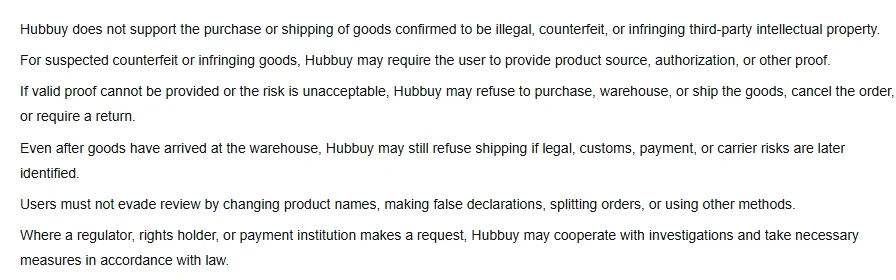
Separately, and more importantly, the operator publishes a handling rule for counterfeit and infringing goods. It says it does not support the purchase or shipping of goods confirmed to be illegal, counterfeit or infringing third party intellectual property; that it may require proof of source or authorisation; that it may refuse to buy, warehouse or ship, cancel the order or require a return; that it may still refuse shipping after the goods have arrived at the warehouse; and that users must not evade review by renaming products, making false declarations or splitting orders.
That is the rule as written, and this site is not going to soften it or grade around it. If you are shopping in this space, the useful thing to know is that the decision point is the warehouse and it stays open after your money has been spent. Who carries the liability for the goods themselves.

The shipping side list, eleven lines and no numbers
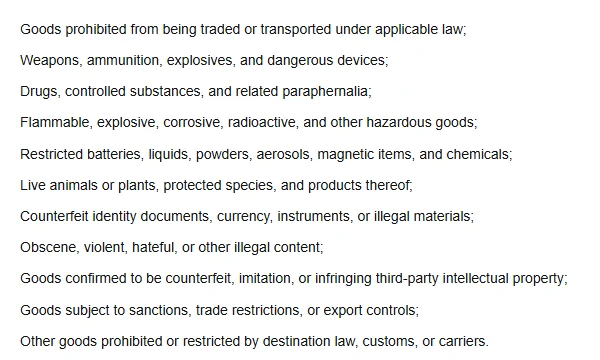
There is a second prohibition list, published under the operator's own name rather than quoted from statute, and it covers the shipping service rather than the purchase. It overlaps the state lists in places and extends them in others. The two extensions that matter for ordinary shopping are the line covering restricted batteries, liquids, powders, aerosols, magnetic items and chemicals, and the final catch-all: other goods prohibited or restricted by destination law, customs or carriers.
That last line is the one to read twice. It moves part of the decision to the country you live in and to whichever carrier ends up holding the parcel, neither of which is visible from a product listing. What your own customs desk does with it.
What the warehouse actually looks at
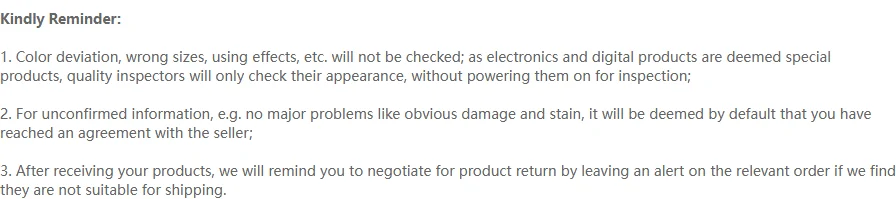
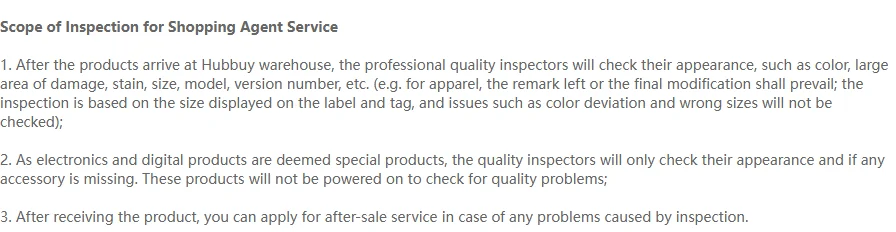
Inspection is the step people most often imagine wrongly, so here is the published scope in the operator's own words. For goods it buys for you, trained inspectors check appearance: colour, large areas of damage, stains, size, model and version number. For clothing, the check is against the size on the label and the tag, and the operator states plainly that colour deviation and wrong sizes will not be checked.
Electronics and digital products are singled out as special products. The inspectors check their appearance and whether an accessory is missing. They will not be powered on. If you are buying something whose entire value is whether it switches on, inspection will not answer that question for you, and the moment it becomes answerable is the moment it is already at your address. How that interacts with a claim.
And what it does not look at, if you shipped it yourself
Forwarding is the other service, and its inspection scope is two lines long because there is almost nothing in it. If the parcel can be signed in, it gets weighed and stored by weight. If it is found to be seriously damaged at sign in, it is rejected or returned directly.
No appearance check, no accessory check, no photographs of the contents. That is the trade you are making when you have a seller post to the warehouse yourself rather than having the operator buy it: you save the purchase step and you give up the only moment anyone would have opened the box on your behalf.

Before you send the link, and after you have
Everything above collapses into a short list of things that are cheap to do at the right moment and impossible to do at the wrong one. The dividing line is the warehouse: once an item is in it, your remaining choices all cost money.
Still free to fix
- Asking the seller to leave out batteries, gift boxes and anything liquid.
- Establishing whether a metal item is solid or plated, before it becomes a restricted export question.
- Checking the liquid volume against the 100 ml limit on the listing page.
- Deciding whether you can live with an electronic item that will never be switched on before it reaches you.
Now costs money
- Removing a built in battery. It cannot be done, so the route changes instead.
- Sending a sensitive item back to the seller because the route you wanted will not take it. The fee ladder.
- Discovering the route you were given carries no cover. Cover by route.
- Arguing about colour or size after inspection has passed it, given the published scope above.
The reminder the operator prints under its own inspection rules
The inspection article does not end with the scope. It ends with three reminders, and the middle one is the most consequential sentence on this page. Where information is unconfirmed, and there is no major problem such as obvious damage or staining, it will be taken by default that you reached an agreement with the seller.
Default agreement is how silence gets read. The first reminder repeats that colour deviation, wrong sizes and usage effects are not checked and that electronics are not powered on. The third is the useful one: where the operator finds goods unsuitable for shipping, it will leave an alert on the order and prompt you to negotiate a return with the seller. That alert is the moment to act, and it is the last one that is free.