
When something goes wrong, the useful question is which stage you are at
Almost every published rule on this site keys off a status rather than off what happened. Not yet purchased, purchased but not shipped, shipped, stocked in, left the warehouse. Working out which one you are at settles most questions before you have to ask anybody.
Order level actions all happen on the operator's own site. This site cannot act on an account.
Four places to take a problem, and what each one can actually do
Worth being blunt about the last of these, because a guide site that implies otherwise wastes your time when you are already in trouble.
Your order page, for anything tied to one specific order
Cancellations, return and exchange requests, and the address while it can still be changed all live there. It is also where the status you need to read is displayed. What each status means for a cancellation.
Customer service, for anything that needs a human decision
The published desk hours are 09:00~18:30 Beijing time, seven days a week. Claims, seizure paperwork and anything involving a seller dispute end up here, because the operator is the only party that can talk to the seller on your behalf.
The published rules, when you want the answer before you ask
Most of what customer service will tell you is already written down. Every page on this site names the article it is reading, so you can go and check the wording yourself rather than take a summary on trust.
This site, for nothing that touches your account
It is independent. It cannot open, cancel, refund, claim or expedite anything. What it can do is tell you which published rule governs your situation and where that rule is written. Corrections to these pages go to [email protected].
Cancelling an order, stage by stage
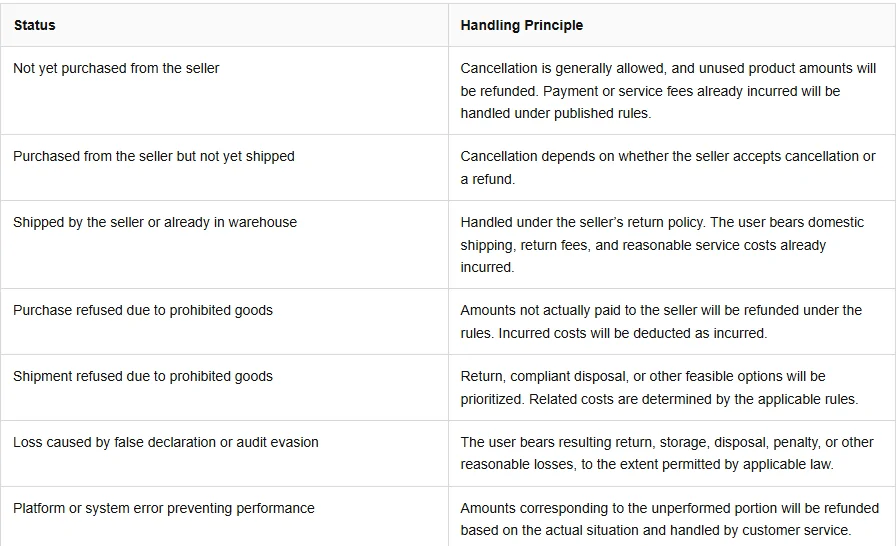
The cancellation rules in the help centre sort every cancellation into seven situations, and the dividing line that matters most is whether the seller has already been paid. Before that point, cancellation is generally allowed and unused product amounts are refunded, with fees already incurred handled under the published rules. After it, the answer stops being the operator decision and becomes whether the seller accepts a cancellation or a refund.
Once the goods have shipped or reached the warehouse the seller return policy takes over, and the table states plainly that you bear domestic shipping, return fees and reasonable service costs already incurred. Three further rows cover refusals on prohibited goods, where amounts not actually paid come back and incurred costs are deducted, and where return, compliant disposal or another feasible option is prioritised for a parcel already in the building. What counts as prohibited.
The two rows at the bottom sit at opposite ends. A loss caused by false declaration or audit evasion is yours, including storage, disposal and penalties. A platform or system error that prevents performance is refunded against the unperformed portion.
Three things that stop being changeable the moment it ships
These sit in an Important Notices block near the top of the compensation rules, above everything about claims, and they are easy to read past. Each one describes a door that closes on its own. Reproduced word for word.
Once the package leaves the platform warehouse, the recipient's address and contact information cannot be changed; Insurance cannot be purchased retroactively after the package has been shipped; The insurance service applies only to the specific single package and is not transferable to other orders.
The Important Notices block of Compensation Standards, read on 2026-09-24.
Which currency each published figure is in
Every number this site reproduces is printed in the currency the operator printed it in, and nothing here is converted. That is deliberate: an exchange rate quoted on a guide page would be stale within the hour and would be wrong for most readers anyway, because the rate you actually pay is applied by your payment provider at the moment you pay rather than by any article.
Already denominated in yuan
- Every ceiling on the insurance attachment, per parcel and per item. There is no second currency column anywhere on that sheet. What the ceilings are.
- The declaration cost named in the services and fees article, given as a general figure of 8 yuan.
- The return and exchange service fee ladder, counted per occurrence and per calendar month. The ladder.
- The uninsured goodwill limit, published as a fraction of commodity value with a ceiling of 1000 CNY an item.
Not settled until later, or not by the operator at all
- The rate you actually pay. It comes from your payment provider at the moment of payment, and no figure on this site depends on it.
- Tariff thresholds, which are the one place other currencies appear at all, because each destination country sets its own. The threshold table and its disclaimer.
- What a claim is measured against, because the published lower value rule compares two amounts that are both taken after coupon deduction.
- What a refund is measured against, because the published note bases it on the price actually paid rather than on the listed price.
Frequently asked questions, answered only where there is an answer
Five frequently asked questions where the operator has published something specific. Where it has not published anything, this page says so rather than filling the gap.
- Can I change the delivery address after the parcel has shipped?
- No. The published notice is that once the package leaves the platform warehouse, the recipient's address and contact information cannot be changed. Before it leaves, the order page is the place to do it.
- Can I add insurance to a parcel that is already on its way?
- No. Insurance cannot be purchased retroactively after the package has been shipped, and cover is published as taking effect the moment the package leaves the warehouse. It is a decision with a deadline.
- If I bought insurance, do I also get the basic compensation policy?
- No. The published wording is that the basic compensation policy and paid insurance claims cannot be enjoyed simultaneously, with no stacking. You are on one track or the other.
- My tracking has not updated in weeks. Is the parcel lost?
- Not yet, by the published test. A parcel is treated as lost on official declaration by the provider, or after 90 days without a logistics update on regular routes, which expressly excludes sea freight, rail and the Brazil special lines. If it is signed for after a payout, the platform reserves the right to deduct the claim back. The full loss rule.
- Nobody has replied. Who else can I ask?
- Only the operator can act on an order, so there is no second queue to join. The desk hours are 09:00~18:30 Beijing time, seven days a week. If you think a page on this site has something wrong, that is a different problem and it goes to [email protected].
What the word refund is doing in that table
The cancellation table closes with one sentence that qualifies every row above it, and it is the sentence to read before working out what you expect back. Three things feed the number: the actual order status, the result the seller gives, and costs already incurred. None of the three is the amount you paid.
That ordering also explains why the same cancellation produces different outcomes for two people. One cancelled before the seller was paid, the other after, and the seller in the second case declined. Nothing about the rule changed between them. How the same logic plays out on a return.

What to have in front of you before you write in
Every published claim path names its own evidence, and in each case the evidence has to already exist by the time you need it. Gathering it afterwards is not possible for any of them.
The order number and the exact status the page is showing
This is what decides which rule applies, so it is the first thing anyone will ask for. The status table.
The inspection photographs, checked before the parcel shipped
The published pre-shipment obligation puts the burden on you to report quantity, appearance or defect problems in advance. Not doing so is read as accepting the condition. How to judge a set.
The unboxing video, continuous and unedited
Required for damage and missing item claims, with the seal visible and intact before opening. Electronics additionally need a power on functional test on camera. The full specification.
The official document, if customs is involved
Seizure claims on the Brazil route name an official customs document and a tracking screenshot by title. A carrier email is not a substitute. What the route requires.