
What customs does to a parcel, and what it costs when one turns around
Two desks can stop a parcel after it has left the warehouse: the one in China that lets it out, and the one in your country that lets it in. The second one is the expensive desk, because by the time it acts the shipping has already been paid.
Declared value and route are both set when the parcel is submitted on the operator's site.
Who writes the declared value, and what it is written against
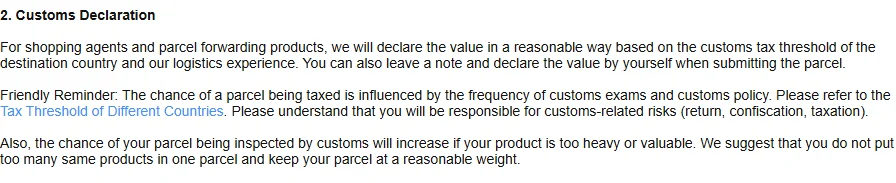
The declared value is not a number you are asked for and it is not a number the seller sets. The operator states that for both its shopping agent and its forwarding products it declares the value in a reasonable way, based on the customs tax threshold of the destination country and its own logistics experience. You can override it: the same clause says you may leave a note and declare the value yourself when you submit the parcel.
Its own framing of the odds is worth reading next to that. The threshold article opens by saying that where the declared value is below the tariff threshold the package normally will not be taxed, adds in parentheses that fraudulent declaration is another matter, and then gives a figure for how often tax actually lands. Both of those are the operator speaking about its own traffic, and both were read on 2026-09-24.

Ten destinations, and the two that have no relief at all
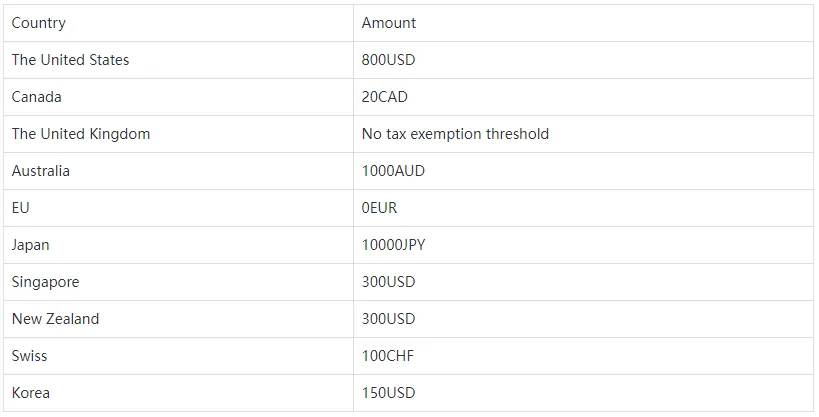
The operator publishes a ten row reference table of tariff thresholds by country, read here on 2026-09-24. It spans five currencies, which is why it is set out below as two lists rather than as one scale: there is no honest way to draw a bar chart across yen, francs and dollars. The figures are the operator's own; the table itself is in the next section and so is the disclaimer it prints underneath.
A stated threshold to stay under
- The United States, 800USD.
- Australia, 1000AUD, the highest number on the table.
- Japan, 10000JPY.
- Singapore and New Zealand, 300USD each.
- Korea, 150USD. Switzerland, 100CHF, with a separate and lower value added tax threshold noted underneath. Canada, 20CAD.
Nothing to stay under
- The United Kingdom, listed as having no tax exemption threshold at all.
- The European Union, listed at 0EUR, which is the same statement written as a number.
- For both of those, a low declared value changes what you are charged, not whether you are charged.
- Canada and Europe are also named in the notes as strict on inspection, with commercial express carriers singled out as the likeliest to be taxed.
The table as published, and the line printed under it
Here is the reference table itself, and directly under it the sentence the operator prints at the end of the same article. The sentence matters as much as the table does, because it tells you what kind of document you are looking at: figures collected from the internet, offered for reference, not standard guidance.
That is an unusually honest label for a page like this, and it is the reason this site reproduces the table rather than restating the numbers as if they were law. Check your own customs authority before you rely on any row of it. Where the rest of these documents live.

Four notes that carry more weight than the table
Underneath the table sit four notes, and between them they say more about what actually happens to a parcel than the thresholds do. The first splits Switzerland into two separate thresholds, a customs one and a lower value added tax one, which is the sort of detail a single figure in a table hides. The second names Canada and Europe as strict in package inspection and says business express carriers such as the named couriers have a large chance of being taxed.
The third is the one to act on. The number of items and the weight of the package are the important basis for customs to judge a parcel as civil or commercial; over a stated weight it is more likely to be read as commercial; and a large number of identical items reads as commercial regardless. The fourth is a single sentence about food, which is worth taking seriously because food is also a sensitive category on the shipping side. Why food is sensitive twice over.

Keeping a parcel looking civil rather than commercial
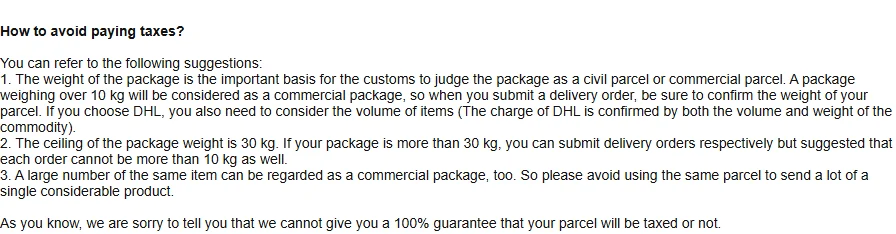
The operator publishes a short list of suggestions under the heading of how to avoid paying taxes. Read as tax advice it is thin. Read as a description of what customs officers pattern match on, it is the most actionable thing in the article, because every one of these is a decision you make when you submit the parcel rather than something that happens to you afterwards.
Watch the weight band, not just the cost
A parcel over the stated weight is treated as commercial. The weight you are quoted on and the weight that decides this are the same number, so it is visible before you pay.
Split rather than stack
There is a hard ceiling on parcel weight. Above it you are told to submit separate delivery orders, and each of those still has to sit under the commercial threshold on its own.
Do not send five of the same thing in one box
A large number of identical items reads as a commercial shipment whatever the total weight is. The note says to separate single items into different parcels.
Remember volume exists for some carriers
For the express carrier named in the article, charges are confirmed by both volume and weight, so a light bulky parcel is not the cheap option it looks like.
What happens at the far end, in one paragraph
The suggestions above end with a sentence that is doing real work: the operator says, in as many words, that it cannot give a full guarantee about whether your parcel will be taxed. Nobody can. What it can describe is the mechanism at the receiving end, and it does that in a separate article that is one paragraph long.
Foreign customs inspection is a spot check. Where a parcel is judged special, meaning bulky, heavy or sensitive, customs will contact the recipient directly for an invoice or for clearance. And then the sting: where the addressee cannot be contacted, or does not cooperate with clearance, the cost of a parcel returned or destroyed is borne by the addressee. That is you, and it is the only clause on this page where doing nothing is the expensive option.

The questions people ask after the first taxed parcel
Answers below are taken from the operator's published articles, read on 2026-09-24. Where an answer is not in those articles, this site says so rather than filling the gap.
- Can I ask for a lower declared value
- Yes. The declaration clause says you may leave a note and declare the value yourself when submitting the parcel. The same article calls fraudulent declaration another matter, and the compensation rules pay out on the lower of declared and paid value, so a low declaration is also a low ceiling on any claim. How that arithmetic works.
- Does the threshold table tell me what I will pay
- No. It tells you where tax starts, not the rate, and the operator labels it reference material collected from the internet rather than guidance.
- Is a courier safer than post
- The notes say the opposite for two regions: Canadian and European customs are described as strict, with business express carriers having a large chance of being taxed.
- Who pays the tax
- You do, at the destination. The customs inspection article describes customs contacting the recipient directly for the invoice or for clearance.
- Is any of this covered by insurance
- Not the tax. And a seizure caused by unpaid taxes, missing customs documents or exceeding a personal import quota is listed as non compensable. The exclusions in full.
Three ways a parcel comes back before it ever leaves China
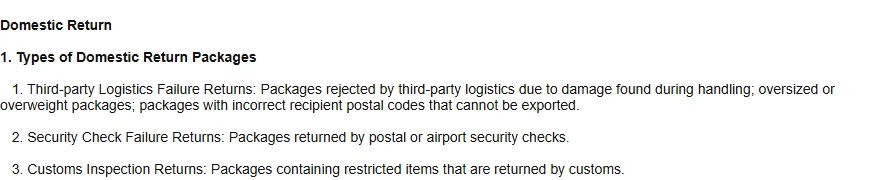
A parcel can fail on the way out as well as on the way in, and the operator separates those failures into three named types: rejection by the third party logistics provider, failure at a postal or airport security check, and return by Chinese customs because the parcel contains restricted items. The third type is where the blocked and sensitive lists cash out into an actual event.
Each type has its own refund rule, and they are not the same. Logistics failure returns get a full refund of shipping. Security check failures also get a full refund, except that where the return happens after the air security check, shipping and registration fees are not refunded. The third is the worst outcome on this page: parcels confiscated or destroyed after a security or customs failure get no refund of shipping and no compensation for the goods. What the lists that trigger this look like.

The sentence the operator puts under its own risk warning
The customs risk article opens by describing what the system does for you: it flags potential risks when an order is submitted and verified, and after the goods reach the warehouse it suggests a low risk shipping method based on the nature of the product and its own experience. Then it says where the risk lands.
Friendly Reminder: Some products are inevitably subject to certain customs risks such as rejection, taxation, and confiscation. Please understand you will be responsible for such risks.
The Friendly Reminder printed under What are the customs risks?, read on 2026-09-24.
Getting it back, and the fee nobody mentions first
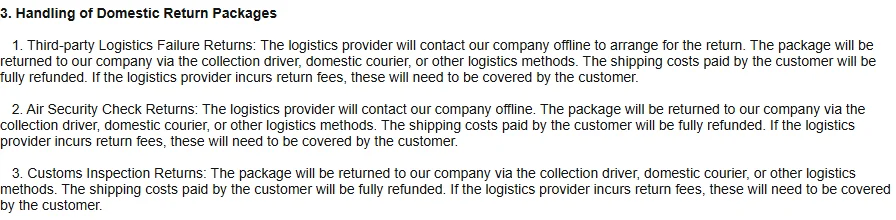
Handling is the same shape for all three domestic return types. The logistics provider contacts the operator offline, the parcel comes back to its company by collection driver or domestic courier, and the shipping you paid is fully refunded. Then the clause that repeats three times, once per type: where the logistics provider incurs return fees, those need to be covered by the customer.
Overseas is harsher and shorter. Where a parcel has already been sent abroad and comes back for customs inspection, international security check failure, no signature, unknown address or being out for delivery, shipping is not refunded and you cover the cost of sending it again. Two of those five reasons, no signature and unknown address, are entirely within your control at the moment you enter the address.

Questions about a parcel that turned around
These are the ones worth settling before it happens rather than during, because a returned parcel is usually also a parcel somebody is waiting to be told what to do with.
- Do I get the shipping back
- For a domestic logistics or security failure, yes, in full. After an air security check, shipping and registration fees are not refunded. For a confiscation, nothing comes back. Overseas, nothing comes back.
- Can I get the goods reshipped
- Domestically, yes, and the operator handles the return into its own warehouse. Overseas, yes, and you pay for the second journey.
- What if I never respond to the return
- For postal channel returns from overseas there is a deadline, after which unclaimed parcels are destroyed with no compensation. The deadline and the channels it applies to.
- Does the tracking tell me any of this
- Not reliably. The status wording is generated by the carrier, not by the operator, and at least one common status means something other than what it sounds like, which is the subject of the last section on this page.
One status word, and what it actually reports
The operator devotes a whole help centre article to a single tracking status, which tells you how often it gets misread. Out of delivery does not mean the parcel is out for delivery and it does not mean it is lost. It means delivery staff attempted the delivery, the receiver was absent or the parcel could not properly be handed over, and nothing was signed for.
The practical advice attached to it is the right advice: once a parcel reaches the destination country it is being handled by the local post office or courier, so the people who know where it is are local, not in China. Contact them. Left alone, an unsigned parcel is exactly the no signature case in the overseas return clause above, and that one costs you the shipping twice.
