
What a claim pays, and the three routes where it pays nothing
Insurance is the only part of this process you are asked to opt into, and it is the part with the widest gap between what the main article says and what the attachment at the bottom of it says. One states a single ceiling for everybody. The other lists a ceiling per shipping route, and three of those routes carry no cover at all.
Cover is chosen at the moment a parcel is submitted, on the operator's site.
What a parcel costs before anything goes wrong
Before the insurance question is worth asking, it helps to know what you are insuring against. The operator publishes the total as a three part sum, and it is a useful sum because two of the three parts are set by somebody other than you.
The item cost belongs to the seller. The customs charge belongs to your country. Only the middle number, international shipping, is chosen at the point of submission, and that is the same choice that decides how much cover you can buy. What the destination desk does with the parcel.

The three numbers, one at a time
Unpacking that sum is where the surprises live. The item cost is not just the price on the listing: it includes the domestic shipping from the seller to the warehouse, which on a cheap item can be a meaningful share of the total. International shipping is calculated from weight, method and destination rather than quoted per item.
The third line is the one worth reading twice. The operator gives the customs declaration cost for a parcel as roughly 8 yuan, depending on the shipping method, and then states that apart from item cost and shipping fee it requires no handling fees, with value added services left to the user. Insurance is one of those value added services, which is why nothing on this page happens automatically.

Getting a shipping figure before you commit
Shipping is the number that moves, and it moves after you have already paid for the goods. Four steps, in the order that gets you a usable figure rather than a shock at the submission screen.
Estimate the weight while you can still change your mind
The operator runs a public estimator that takes a weight and a destination and returns route options. It is worth using before the item is bought, not after. The shipping estimator.
Pick the destination country first
Routes are filtered by destination, and the set on offer to one country is not the set on offer to its neighbour. The cheapest line to Germany may not exist at all for Brazil.
Write down the route name, exactly as it is spelled
The insured amount sheet is indexed by route name and nothing else. Two routes that differ by one letter can differ by 3000 in cover, and that is not a hypothetical.
Add the customs charge and the premium separately
Neither of them is inside the shipping quote. The declaration cost is a flat administrative line, and the premium is a rate applied to goods plus shipping. What your destination taxes.
What the service is, and what the premium is charged on
The definition is short and it is worth quoting in its plain form: insurance is the process of insuring your package, and once it takes effect, in the event of a package loss, the operator compensates you for the loss. Loss. Not damage, and not disappointment with what the seller sent.
The premium is a rate applied to the total value of goods plus the actual paid shipping fee, so a slow cheap route costs less to insure than a fast expensive one carrying the same goods. Two kinds of cover are named: package loss in transit by the logistics carrier, and loss of the entire package to customs clearance problems. Everything else is decided by the exclusion lists further down this page.


The line at the bottom of the compensation article
The compensation standards article runs to eleven numbered sections and then ends with a link. That link is the whole reason this page is organised the way it is, because what sits behind it does not match what sits above it. It is reproduced here exactly as published, typing slips and all.
Click to view detailed graphic expianation of insurance ruies: Open image (New Window)
The closing line of Compensation Standards, read on 2026-09-24.
The table at the other end of that link
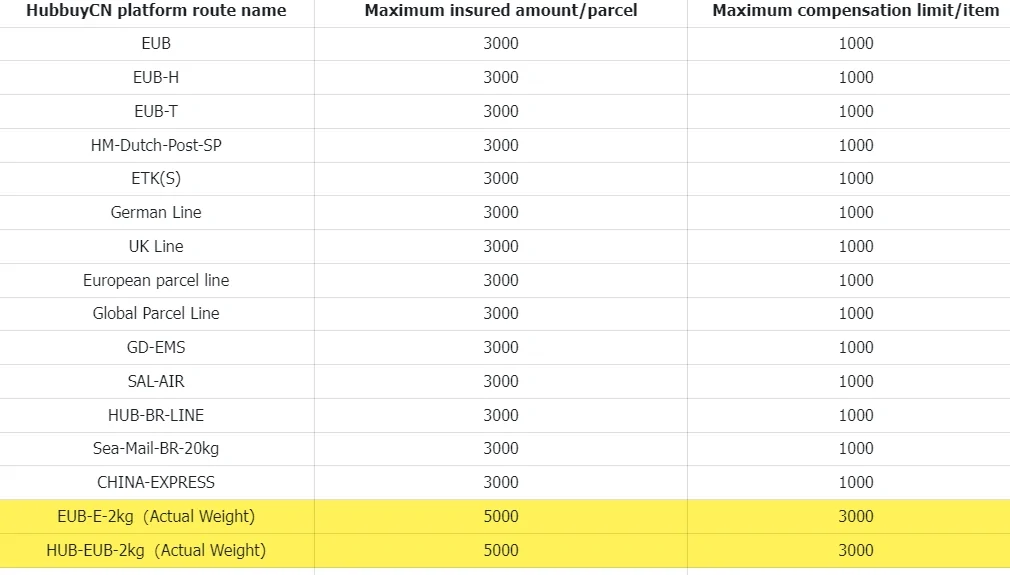
Behind the link is a single long image listing roughly one hundred and twenty shipping routes by name, each with a maximum insured amount per parcel and a maximum compensation limit per item. Most rows carry the same pair, and that pair matches the ceiling stated in the main article.
A minority do not. The two highlighted rows at the foot of this crop carry a higher ceiling than every row above them, on lines that differ from the ordinary EUB entries only by a weight qualifier. Nothing in the main article mentions that these exist. The header of the table still carries the operator's previous brand name, which is one way of dating it.
Three routes where the published ceiling is zero
This is the finding worth carrying away from the page. Further down the same attachment, three route names carry a zero in both columns. Not a lower ceiling, and not a caveat: zero insured amount and zero compensation per item. On those lines there is nothing to buy, whatever the premium calculator lets you do.
The bars are drawn to one scale so the comparison is honest, and the first row is an ordinary line from the same crop so you can see what normal looks like. Nothing here is this site making a judgement; every figure is read off the attachment on 2026-09-24.

Ceilings published against each route name, per parcel and per item, in yuan
LDT-DHL-Fexpress
The row immediately above the zeros, carrying the pair almost every route in the attachment carries.
LT-HKUPS-6000tax not included
Zero in both columns. There is no amount you can insure on this line.
LT-HKUPS-7000tax not included
Its sister line is identical, so this is not a transcription slip.
WS-BR-lineactual weight
A third zero row sits further down the same sheet, outside this crop.
The Brazil rows, and why they are worth checking twice
Brazil is the destination where the attachment is least consistent. Some Brazil lines carry the ordinary pair. Others carry a higher ceiling. One carries nothing. They are not grouped together in the table, and the names are similar enough that picking the wrong one at submission is an easy mistake to make.
The practical rule is the same one that applies to every destination, only sharper here: read the route name off the submission screen, then find that exact string in the attachment before you decide what to insure it for.

Brazil also has its own rules inside the insurance article
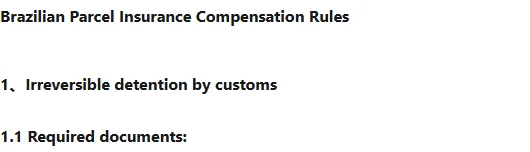
The route sheet is not the only place Brazil is treated separately. The insurance article carries a dedicated block of Brazilian parcel compensation rules, opening with irreversible detention by customs and the documents a claim on that basis requires.
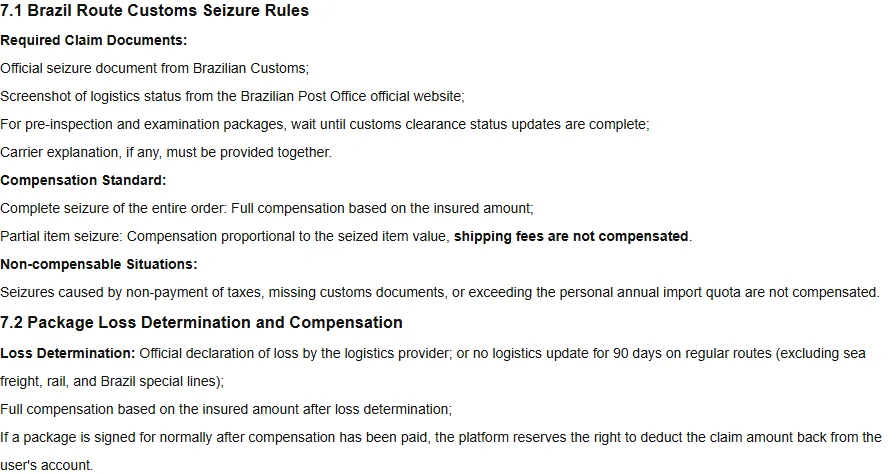
This matters because it changes what you need to have kept. On most routes a claim rests on the carrier tracking. On this one it rests on paperwork issued by a third party, and paperwork issued by a customs authority is not something you can obtain retrospectively if you did not follow the case while it was open. What the seizure rules ask for.
Which of the two values actually gets paid
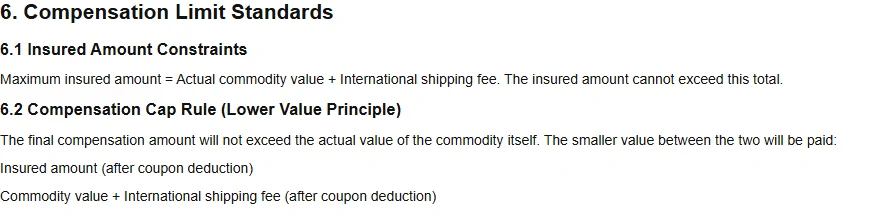
Buying more cover than the goods are worth does not buy a larger payout. The published rule caps the insured amount at the actual commodity value plus international shipping, and then caps the payout again at whichever of two figures is smaller: the insured amount after coupon deduction, or the commodity value plus shipping after coupon deduction.
The two worked examples published underneath make the direction of the rule unambiguous, and they are worth reading as a pair, because one of them runs the other way. Over insure and you are paid the goods. Under insure and you are paid the cover. The number you choose only ever sets the ceiling, never the floor.

What a claim rests on, and what quietly ends one
Nothing in the published rules asks you to prove that a parcel was lost. They ask for a specific set of artefacts, and every one of them has to exist before the loss rather than after it. The split below is drawn entirely from the compensation standards article and the unboxing rules; nothing in it is inferred.
Keep these from the start
- The route name exactly as it appeared at submission. Cover is indexed by route, not by account. The attachment that does the indexing.
- An unedited video of the sealed parcel being opened, with the tamper proof seal visible before the first cut. The five rules.
- For Brazil, the official seizure document and a screenshot of the tracking status from the Brazilian Post Office site.
- The carrier explanation, if one was issued, submitted together with the rest rather than later.
Any one of these ends it
- Tracking that shows a successful delivery. The rules treat that as closing the question regardless of what you received.
- An address or phone number that was wrong, a refusal to accept, or a parcel left uncollected at a pickup point.
- Non payment of duties, or not supplying clearance documents when the destination asks for them. What that desk asks for.
- A false declaration, a concealed item, or anything off the prohibited and restricted lists. The lists.
Seizure, loss, and what happens when there was no cover
Two thresholds decide when a parcel counts as lost rather than late. Either the logistics provider declares it officially, or tracking stops updating for 90 days on a regular route, with sea freight, rail and the Brazil special lines carved out of that clock. After that, the published standard is full compensation against the insured amount.
Seizure is handled proportionally: the whole order taken is paid in full against the insured amount, part of it taken is paid in proportion, and in neither case is shipping compensated. And if the parcel is signed for after a claim has been paid, the rules reserve the right to take the money back out of the account. For parcels with no cover at all there is still a published floor, but it is a third of the goods value and capped at 1000 per item.

Questions worth settling before you tick the box
Five things the two articles answer directly, collected here because they are answered in different places and none of them is answered on the screen where the decision is actually made.
- Does insurance cover damage
- No. Both articles say so separately: the insurance article closes its list of situations that are not covered with damage to goods, and the compensation article excludes product functional failures and man made damage. Cover is for the parcel going missing, not for what is inside arriving broken.
- What is the premium actually charged on
- Total value of goods plus the actual paid shipping fee, multiplied by an insurance rate. Shipping is inside the base, so the same goods cost more to insure on a fast route than on a slow one.
- If I insure for more than the goods are worth, what gets paid
- The smaller of the two figures, after coupon deduction. The published examples put 600 against 800 and pay 600. The rule and both examples.
- How long does a parcel have to stop moving before it counts as lost
- 90 days without a logistics update on a regular route, or an official declaration of loss from the provider, whichever comes first. Sea freight, rail and the Brazil special lines are excluded from that clock.
- What if the parcel turns up after the claim is paid
- The published rule reserves the right to deduct the claim amount back from the account. A late parcel is not a windfall.
Two exclusion lists, published in two different articles
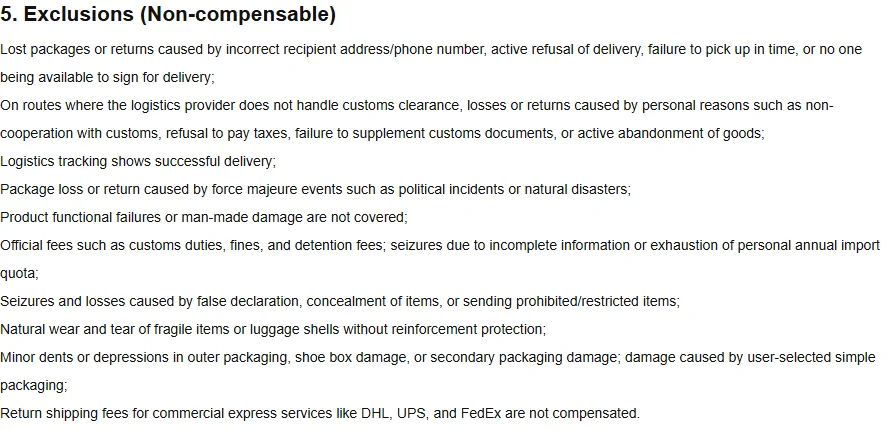
This is the part most worth reading in full, and it is split across two pages of the help centre. The insurance article carries a short list of five situations that are not covered. The compensation article carries a longer one running to ten clauses. They overlap but they are not the same list, and the longer one contains things the shorter one does not mention at all.
The clauses worth noticing are the quiet ones. Minor dents in outer packaging and shoe box damage are excluded by name. So is damage caused by a simple packaging option you selected yourself. So are return shipping fees on commercial express services. And natural wear on fragile items or luggage shells without reinforcement protection is excluded, which turns the optional packing upgrades into an insurance decision rather than a cosmetic one.

The video the claim rules expect you to already have
There is a separate published article on how a parcel has to be opened for an insurance claim to be considered, and it is the one rule on this page that costs nothing and is impossible to satisfy retrospectively. Five steps, and the closing sentence reserves the right to decline a claim if any of them is skipped.
The binding part is the first step and the second. The seal has to be visible and intact before the first cut, and the recording has to be continuous and unedited. A video that starts after the box is open proves nothing about what was in it, which is exactly the point the rule is making. Where the rest of the help centre lives.

Four things to do before you pay a premium
None of these takes more than a minute, and all four have to happen before the parcel ships rather than after something has gone wrong.
Look up the route name in the attachment
Not the destination, and not the carrier brand. The exact route string from the submission screen. Three of them carry no cover at all. The zero rows.
Set the insured amount against what you paid
Cover above the goods value plus shipping cannot be claimed, so paying a rate on it is money spent on nothing. The lower value rule.
Decide the packaging question as an insurance question
Fragile items and luggage shells without reinforcement are excluded from wear claims by name, which makes the reinforcement option part of the cover rather than an extra.
Film the opening, every time
It is free, it takes a minute, and it is the only piece of evidence in the whole process that you control entirely. The five steps.